
Does Vivo have a future in India?

The company was in the business of trading mobile phones. The entity procured phones and accessories from Vivo Mobile India Pvt. Ltd and sold them to distributors in Himachal Pradesh, Jammu, Kashmir, Leh and Ladakh.
Zhengshen Ou and Zhang Jie opened bank accounts with HDFC Bank. And the plot thickened from here on.
According to a chargesheet from India’s Directorate of Enforcement (ED), the body responsible for enforcing economic laws and fighting economic crime, the duo used forged identification documents and falsified addresses. One of the addresses mentioned was a government building and the house of a senior bureaucrat. They used false driving licences to apply for director identification number and open the bank accounts, the ED alleged. In fact, four foreign nationals from the company had forged driving licences.
Why did they forge the identification documents?
The plot further thickened. From the ED charge sheet, we learn that the link between Grand Prospect International Communication and Vivo Mobile India wasn’t that of simple trading.
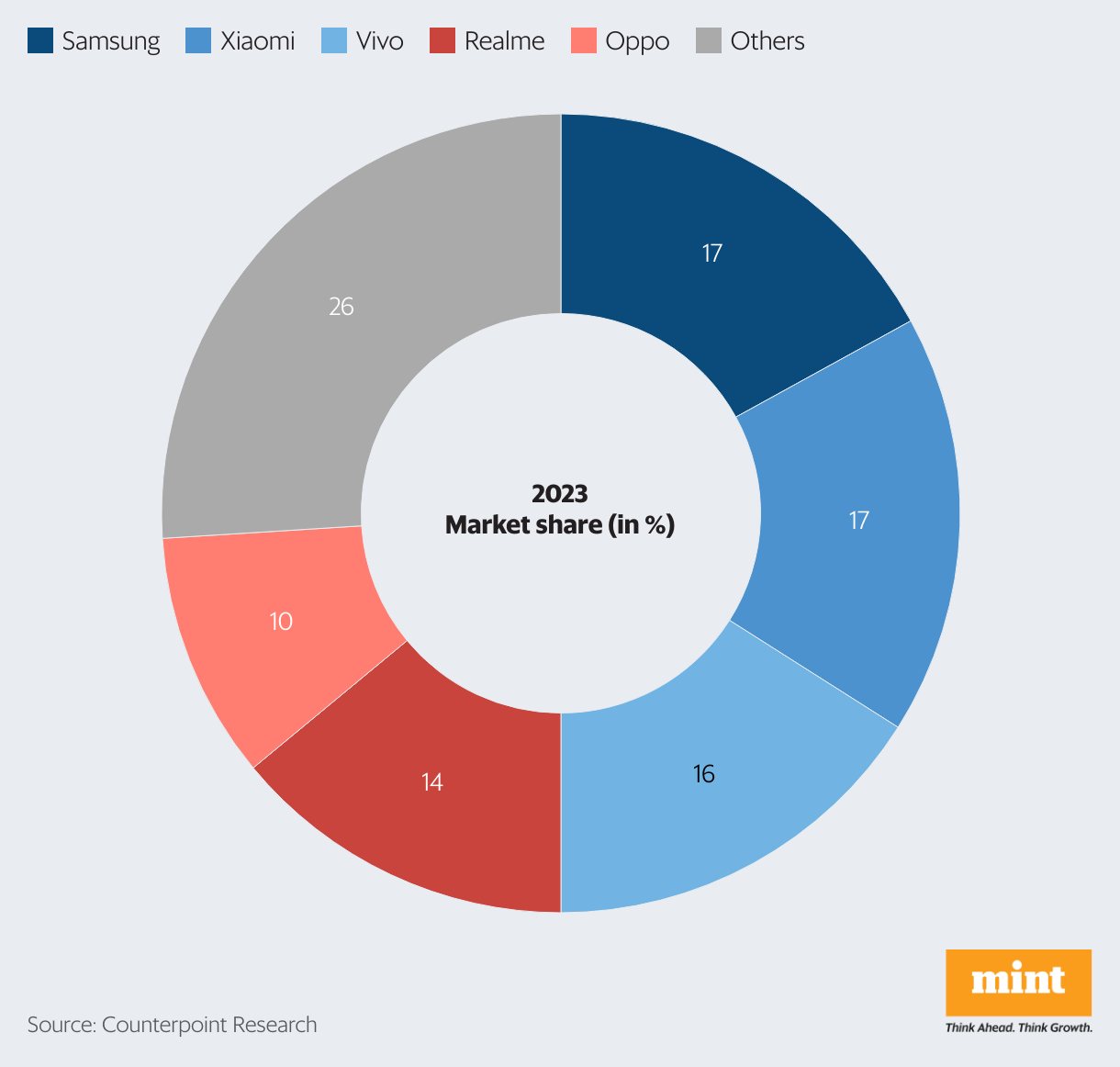
Vivo Mobile India was incorporated just four months before Grand Prospect International Communication started, in August 2014. Vivo is a Chinese company founded in 2009 at Dongguan, an industrial city in China. The company grew rapidly to become one of the most recognized smartphone makers. Thus far, it had a dream run in India, too, and as of December last year, is the country’s second largest smartphone seller with a market share of 16%. Around 2017, it had a market share of 5%. Nonetheless, investigations by ED have rocked the boat, spreading fear among the company’s management and senior employees.
“M/s GPICPL (Grand Prospect International Communication) was part of the complex money-laundering structure created by concealing its true ownership from Indian government authorities in a fraudulent manner using forged identity documents. Analysis of financial statements of GPICPL also reflect economic control of Vivo India over it. Investigation has clearly established that M/s GPICPL is controlled by Vivo India, which, in turn, is controlled by M/s Vivo Mobile Communication Co Ltd, China,” the ED charge sheet, dated 6 December 2023, stated.
“However, on paper, the relation with Vivo India and Vivo China was kept concealed and they were falsely shown as separate legal entities before the Indian government authorities as disclosing the beneficial owner and controller of these entities would have exposed them to government scrutiny,” the charge sheet further added.
The ED first carried out searches at Vivo India and its associated companies on 5 July 2022. By then, Zhengshen Ou and Zhang Jie had left India. Grand Prospect International Communication wound up operations after the investigations began.
Vivo India created a web of many entities similar to Grand Prospect International Communication—at least 17 more companies—siphoning off nearly ₹71,000 crore to China, the ED alleged.
Several arrests have been made and a court room drama is expected soon. We will return to the charges in a bit. But currently, a larger question looms. Will the probe and the legal battles dent the smartphone maker’s brilliant run in India? How did the company script such a success story in the first place?
The rise
The chief executive officers (CEOs) of Vivo India, all foreign nationals, have had very short stints. Between 2014 and now, five chief executive officers (CEOs) have served the company—Ye Liao (2014); Alex Feng (2015); Kent Cheng (2016); Jerome Chen (2019) and Hong Xuquan (2021/22). Hong Xuquan is an interim CEO. He was taken into custody by ED in December and then released on bail.
Interestingly, the frequent changes at the top did not disrupt the momentum of the company’s sales. Vivo entered India at an opportune time. BlackBerry devices, a rage in the corporate world for many years, were on its last legs. Nokia was on a steady decline. Amazon had entered India and the competition with Flipkart, India’s home-grown e-tailing platform, had intensified. That opened up cheaper channels to sell phones. But Vivo didn’t want to be just an online-only brand. It pushed offline sales aggressively with the belief that India was a strategic market, second in importance after the home market of China.
In 2017, one of the writers of this story, drove down from Chennai airport to Puducherry. The route was a sea of blue (Vivo) and green (Oppo) signboards. Oppo is yet another Chinese electronics manufacturer that grew fast in India.
The focus on the offline market worked since the competition—the likes of Xiaomi and Samsung—were moving towards online platforms. The brick-and-mortar retail approach meant that Vivo was offering higher-than-competition margins to retailers. That ensured reach, even to India’s smallest towns in the shortest possible time. Even in multi-brand outlets, Vivo stationed two salaried employees to push sales.
“Our focus was the retailers and if Samsung gave a 5-6% margin, we offered 10-12%. If retailers allowed us to advertise on sign boards in front of their shops, we offered an additional 0.5-1% margin,” a former Vivo employee, who worked with the company between 2017 and 2019, said.
“Samsung had that brand pull and we had to compete with all marketing models and focus on products to get the customers,” the executive, who didn’t want to be identified, added.
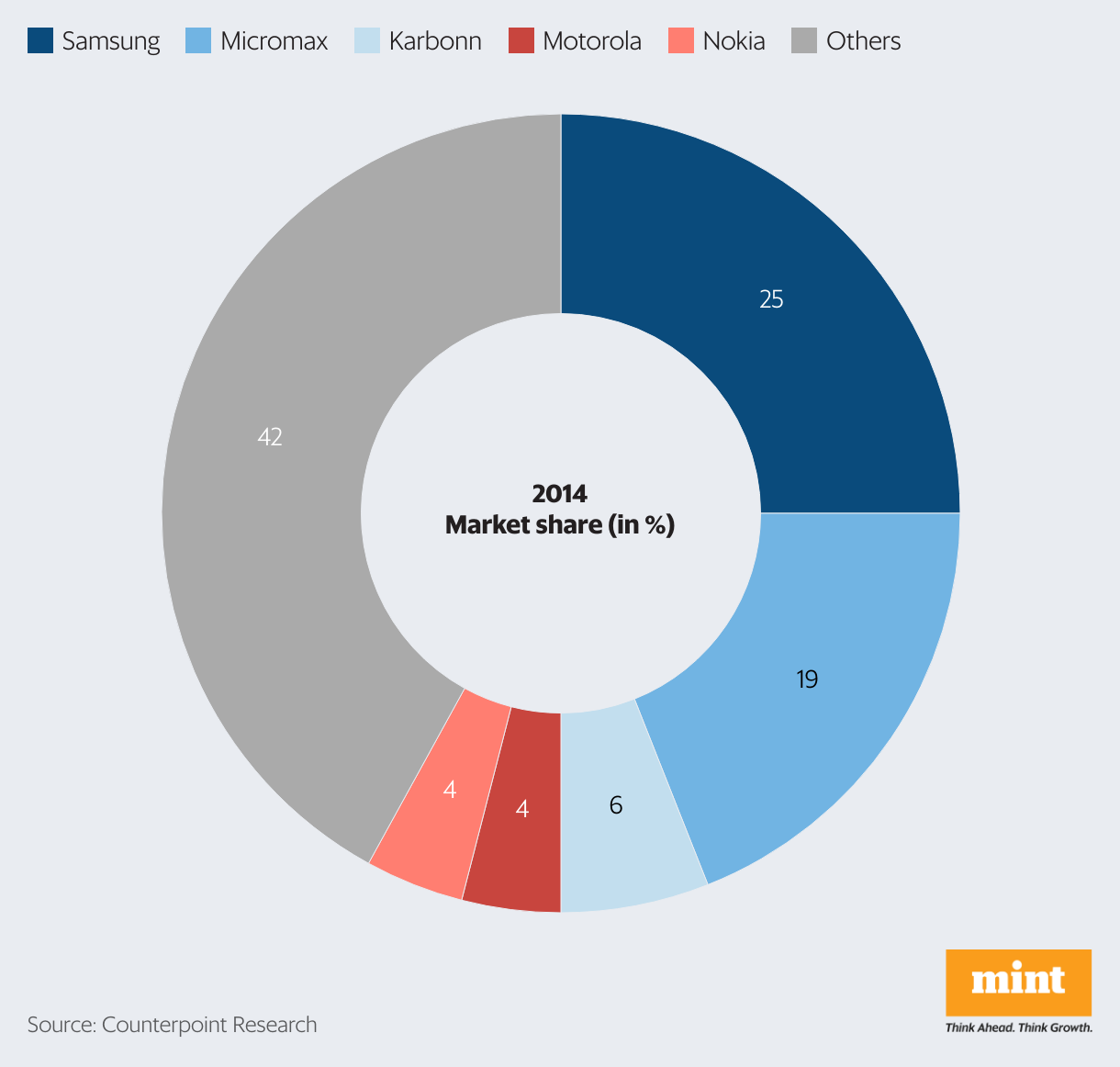
In 2014, Vivo introduced X5 Max, one of the slimmest devices at that time, followed by Moonlight selfie in V5+ in 2016 and then Nex in 2018, which had a pop-up camera and in-display fingerprint. The product innovations helped it break through the clutter and get consumer attention at a time when the market was dominated by Samsung, Nokia, Motorola and even Indian players like Micromax and Karbonn.
“Vivo’s main game plan in 2014 and for the next few years was to focus on the products. They were the first to come up with the slimmest phone at a time when consumers were holding heavy phones and there was not much focus on looks,” said Tarun Pathak, research director at Counterpoint Research.
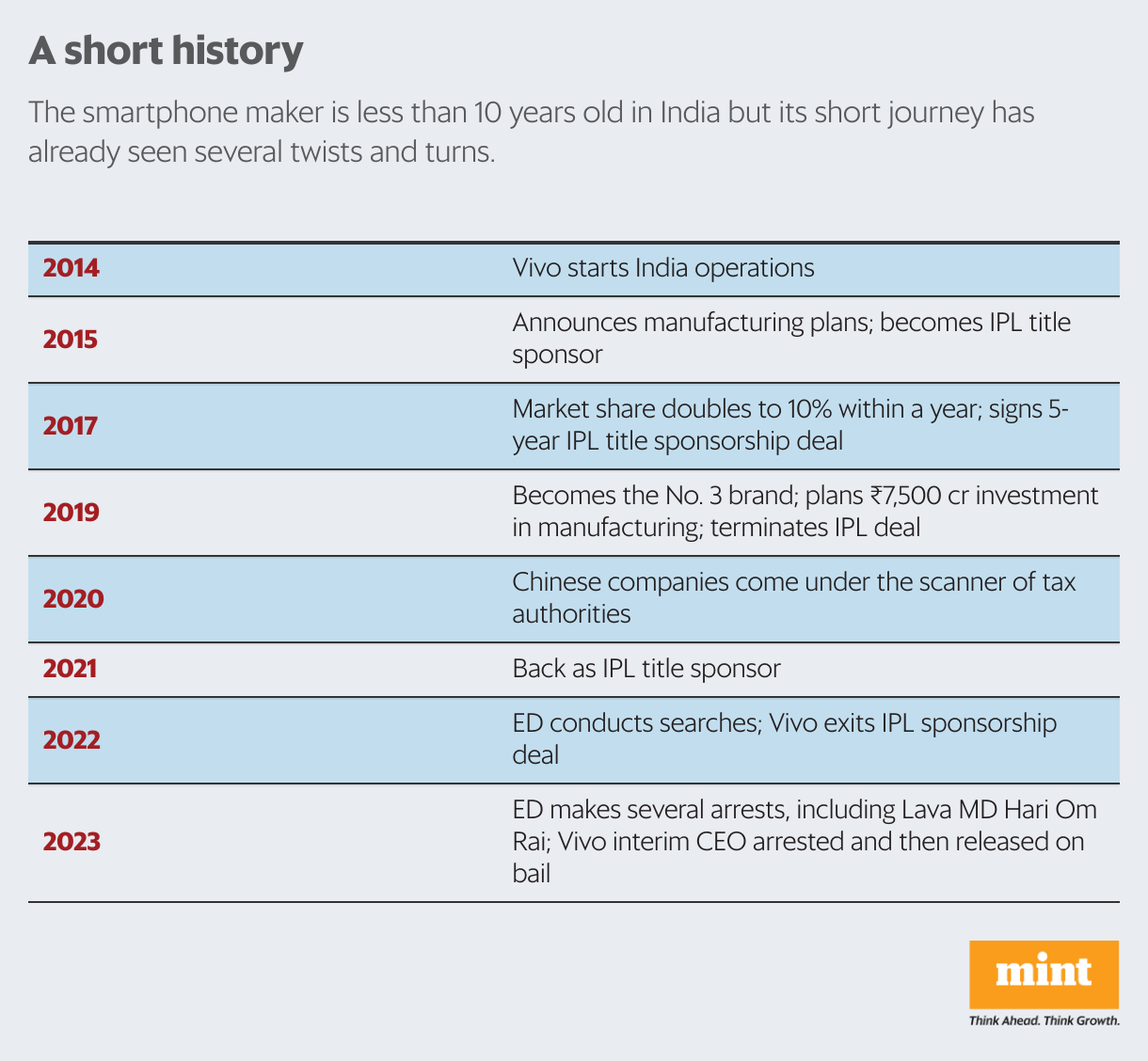
From a brand recognition perspective, the Indian Premier League (IPL), the popular Twenty20 cricket league, did the trick. In 2016, Vivo signed a two-year contract with the Board of Control for Cricket in India by making a bid of ₹100 crore per year for IPL title sponsorship. Two years later, it paid ₹2,199 crore to retain the title sponsorship for the next five years. Amid scrutiny by government agencies, Vivo terminated its agreement to sponsor the IPL tournament in 2019 but was back in 2021 as the title sponsor. It exited yet again in 2022—Tata Group is now the chief sponsor of the tournament.
Meanwhile, the Indian government’s thrust on import substitution, re-established India as a phone manufacturing destination. Vivo invested in local phone assembly in Greater Noida, Uttar Pradesh.
The company began local assembly in 2015 and in 2019 earmarked ₹7,500 crore to expand manufacturing. In 2023, Vivo said that it will double annual manufacturing capacity to 120 million units from the existing 60 million. A new facility is expected to go live this year.
The change
In mid 2017, a military standoff between India and China in the Doklam region, an area claimed by both China and Bhutan, triggered a backlash against Chinese brands in India. But that was a temporary blip. Geo-political tensions, however, continued to escalate following the 2020 Galwan Valley face-off.
India’s policies on foreign investments started changing. The country amended its rules for foreign direct investments, especially those flowing from countries that shared a land border. India also moved to prevent opportunistic takeovers of Indian companies during the pandemic. Chinese smartphone brands—Vivo, Oppo and Xiaomi— came under the taxman’s scanner. Rajeev Chandrasekhar, minister of state for electronics and IT, said in the Parliament last year that the three companies have evaded taxes, including customs and goods and services tax (GST), amounting to ₹9,000 crore between 2018-19 and 2022-23. The minister added that Vivo evaded taxes worth ₹2,923.25 crore, comprising ₹2,875 crore in customs duty and ₹48.25 crore in GST

View Full Image
The fall
Like we mentioned earlier, the ED first investigated Vivo in July 2022—44 locations belonging to the company were raided across north India. In December last year, the probe agency levelled charges of criminal conspiracy, concealment of beneficial ownership and money laundering among others against more than a dozen present and former employees of Vivo India, besides several entities. The agency alleged that multiple Indian laws were violated by Vivo China and, since inception, Vivo Mobile India siphoned off ₹70,837 crore to foreign companies controlled by Vivo China.
Eight forged driving licences were used by foreign nationals to open bank accounts of various state distributor companies and get director identification numbers. The forged IDs could have been used in activities that posed a threat to national security, ED stated.
The agency’s investigations found that Hari Om Rai, Indian phone maker Lava International’s managing director, had assisted Vivo China in incorporating the state distributor companies which were, on paper, shown as independent legal entities, but their finances were controlled by Vivo India. The investigation further found that there was complete Chinese control over the Indian entities. This was deliberately concealed from Indian authorities.
ED arrested Rai, chartered accountants Nitin Garg and Rajan Malik, and Guangwen Kyang, a Chinese national, for wrongdoing under the Prevention of Money Laundering Act in October last year. They remain under judicial custody as of 10 January.
Vivo India’s interim CEO Hong Xuquan, chief financial officer Harinder Dahiya and consultant Hemant Munjal were also held on charges of money laundering on 21 December. However, the three were released by a trial court, which was challenged by ED in the Delhi High Court. The High Court upheld the release but ordered the executives to not leave the country.
“We are deeply alarmed by the current action of the authorities. The recent arrests demonstrate continued harassment, and as such induce an environment of uncertainty amongst the wider industry landscape. We are resolute in using all legal avenues to address and challenge these accusations,” Vivo India said in a statement when the executives were arrested.
The company did not respond to Mint’s requests for clarifications. Queries sent to Lava International and Nitin Garg did not elicit any response either. HDFC Bank did not get back on the clarifications Mint sought on the bank accounts opened using forged documents.
The future
Let’s circle back to the question of what happens to Vivo India from now on. Does it have a future in the country?
Chinese phone makers, despite all the scrutiny and bad press, have continued to do well. In fact, they command over two-thirds of the market today. As per data from TechArc, a research and consulting firm, the share of Chinese brands and their sub-brands totalled 72% in 2023, compared to 68.5% in 2022.
This leads market watchers to believe that Vivo India might survive the legal battles and its fallout.
“While an ED investigation does jitter the confidence of partners to some extent, in the past, we have seen that such issues haven’t had a major impact on business performance,” Faizal Kawoosa, co-founder at TechArc, said.
“To consumers, the origin of the company doesn’t seem to matter. The crucial factors remain product quality at affordable prices and the physical presence of the store close to them,” said an industry executive, asking not to be named. In addition, there are no quality Indian brands that can currently challenge the dominance of the Chinese phones, he added.
Nonetheless, the current trouble does have implications on retailers and employees.
According to a retailer based out of Gujarat, in Vivo India’s early years, the company took its business partners for parties in fun locations, like Bangkok. “The margins we received were in double digits at one point and rivals were not even close. Now, after the ED raids, the parties have stopped. And the company is offering 2-3% margins,” he said.
Vivo India did not respond to a clarification sought on the margins offered to retailers.
The fallout is far worse for employees, particularly senior employees. Potential employers are not entertaining their CVs. According to industry executives, present and even past Vivo employees are living in fear. “There is a concern that investigation agencies may call them for questioning anytime or arrest them. Any employer would want to avoid that,” said a human resources executive asking not to be named.
All this implies low employee morale, which can impact operations. Vivo India, clearly, has a lot to work on—reassure employees, retailers, distributors, suppliers. All this while fighting serious allegations of fraud and money laundering.

View Full Image
