AMD Joins Elite $1 Trillion Valuation Club as Stock Hits Record $616 in Historic 2026 Rally

A Historical Milestone for Advanced Micro Devices
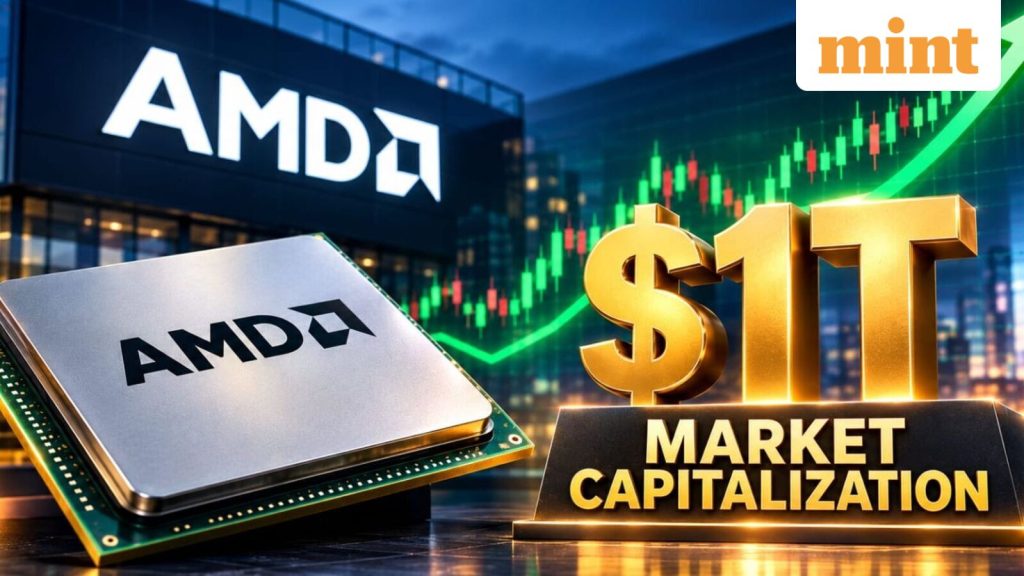
In a landmark event for the global technology sector, Advanced Micro Devices (AMD) has officially crossed the $1 trillion market capitalization threshold. The historic achievement follows a powerful single-day surge of 10 percent, pushing the company’s shares to an all-time high of $616. This sharp movement caps off an extraordinary market trajectory, with AMD equity accumulating over 180 percent in gains over the course of 2026.
By joining the exclusive trillion-dollar market valuation club, AMD cements its transformation from a historical underdog in personal computer processing into an indispensable titan of global compute infrastructure. Wall Street’s aggressive backing reflects widespread confidence in the chipmaker’s ability to capitalize on the massive infrastructure expansion required by advanced artificial intelligence applications.
From Corporate Turnaround to Semiconductor Powerhouse
AMD’s journey to a $1 trillion valuation represents one of the most significant corporate turnarounds in modern tech history. Just over a decade ago, the company faced daunting financial headwinds, constrained capital resources, and shrinking market share in client computing. A pivotal strategic pivot focused on modular chiplet architectures and energy-efficient designs laid the groundwork for a systematic resurgence.
Under disciplined strategic leadership, AMD progressively dismantled legacy technological bottlenecks. The introduction of its groundbreaking Zen processor architecture allowed the firm to steadily capture enterprise server share with its EPYC family of processors. This strong foundation in data center CPUs created the balance sheet capacity and operational infrastructure required to mount a serious challenge in high-end graphics processing and AI computational units.
Core Catalysts Driving the 2026 Stock Surge
The primary driver behind AMD’s relentless market momentum is the structural shift toward artificial intelligence hardware. Enterprise corporations, research institutes, and cloud hyperscalers are deploying generative AI models at an unprecedented scale, leading to a structural supply shortage of advanced processing units. Several critical factors have catalyzed investor enthusiasm:
- Surging Demand for AI Accelerators: Large-scale technology enterprises seeking alternatives to hardware single-sourcing have rapidly integrated AMD’s Instinct series accelerators into their primary data center builds.
- Multi-Billion Enterprise Commitments: Key cloud providers and digital platforms have finalized multi-year procurement deals, providing predictable long-term revenue streams for AMD’s data center segment.
- Enterprise Data Center Dominance: AMD’s server processor business continues to post robust, high-margin growth as cloud providers migrate traditional enterprise infrastructure to EPYC architecture.
- Improved Manufacturing and Supply Velocity: Strategic relationships with leading semiconductor foundries have ensured robust yield rates, allowing AMD to fulfill large-scale orders faster than historical averages.
Macroeconomic Factors and Energy Infrastructure
Beyond internal product execution, broader economic factors have provided substantial tailwinds for the semiconductor industry. Chief among these trends is a notable decline in global energy costs, which has reshaped the economics of mega-scale data center operations.
Modern AI processing hubs are extraordinarily power-intensive, making electricity costs one of the single largest operating expenses for infrastructure operators. The recent easing of energy prices across key computational markets has significantly reduced the total cost of ownership (TCO) for running high-density server clusters. With operational expenses stabilizing, enterprise customers have unlocked additional capital expenditure budgets to purchase advanced processing units, directly benefiting equipment suppliers like AMD.
Navigating the AI Arms Race Against Nvidia
Despite reaching the $1 trillion mark, AMD operates in a fiercely competitive environment where Nvidia long held a near-monopolistic grip on the market for AI chips. Nvidia’s early ecosystem investments, particularly its proprietary software stack, created high switching costs for developers accustomed to its environment.
In response, AMD has aggressive pursued an open-source framework strategy. By continually upgrading its open ROCm software ecosystem, AMD has systematically reduced the integration friction for developers looking to port enterprise AI software across different hardware platforms. This commitment to interoperability has allowed major cloud vendors to deploy AMD chips into existing infrastructure with minimal operational friction.
Nevertheless, analysts emphasize that AMD must navigate lingering market risks. Persistent inflation concerns, potential supply chain disruptions, and intense technological counter-offensives from established rivals present ongoing operational challenges. Maintaining execution speed will be essential to protecting its newfound trillion-dollar market standing.
Conclusion
AMD’s entrance into the $1 trillion market cap club marks a structural shift in the global technology landscape. Driven by massive enterprise demand for AI hardware, continuous architectural innovation, and favorable macroeconomic conditions, the chipmaker has secured its position as an essential pillar of modern computing. As the global digital economy becomes increasingly reliant on high-performance compute capabilities, AMD stands uniquely positioned to influence the future of artificial intelligence hardware.