
 Aniket Pujari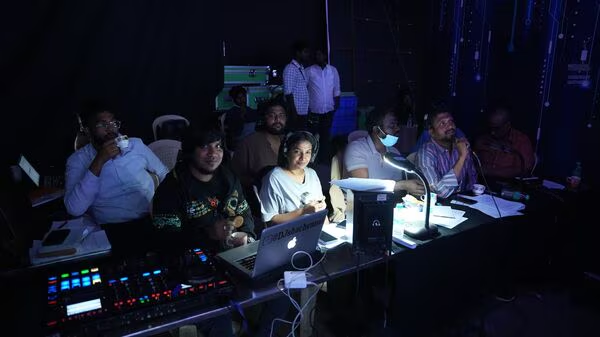
Startup Singam is a Tamil pitch show on Star Vijay (Vijay TV), also streaming on JioHotstar.
The show’s title track slips an instruction into the chorus: “To reach the dream, knock on the door”. Its premise is that the knock can be in Tamil—but it still opens the door to people who speak in English, in metros.
Kannan, an electronics and instrumentation engineering graduate (class of 2008), spent almost 15 years in IT before quitting on 18 May 2025, when his monthly salary was about ₹5 lakh.
In 2021, back home for a temple festival in Nambiyanvilai village, in Tirunelveli district, he watched about 30 palm trees being cut down in bulk. He’d been seeing palms cut since childhood. This time, he stopped and asked why.
The farmer was afraid of what the fruit attracted. Fallen fruit drew wild pigs; the pigs destroyed the peanut crop next door.
“My concern is only the palm fruit,” the farmer told him. Harvest it—eat it as an ice apple, tap the tree for neera—just keep the fruit from bringing the pigs.
Then, he made an offer: Kannan could access roughly 200 trees for free, because the farmer was losing more than he was gaining.
Palm Era’s innovation was not flashy. It was practical. Palm jaggery clumps, sweats, unlike white sugar. The company’s solution was to turn it into a fine granular powder—free‑flowing, without additives. The decision began with the weather (blocks melt; fungus appears) and with a domestic absurdity: a friend tried to crack a hard block with a hammer and broke a kitchen stone instead. Kannan decided the brand should do the breaking.
His other corporate reflex was packaging. If you want an unglamorous ingredient to read as premium—if you want it on “elite people’s plate,” as he put it—you make it look like it belongs there. Within six or seven months, a company in the United Arab Emirates offered ₹25 lakh for the brand and packaging even while he was losing money. Kannan called his father and joked, “Dad, I’m getting a car.” His father asked him: “Is this what you’ve been struggling for all these days?”
The struggle, for Kannan, is less about jaggery than palms. He comes from a palm-climbing community. In his village, he was the first engineer. Climbers in 2021 earned around ₹20,000 a month—and only for about four months of the season—after spending hours up the tree morning and evening. Palm Era’s “premium” story, he said, was built to change that math. He says climbers working with him now make roughly ₹1–1.5 lakh a month in season, directly benefiting about 40–50 families.
Kannan almost didn’t end up on Startup Singam. The first email from the show’s team, he assumed, was spam. It was only after he won a social impact startup award from Startup Tamil Nadu in 2023 that the state’s startup team nudged him to apply in early 2024.

View Full Image
Startup Singam’s first season, which premiered on 26 January 2025, ran like a weekly funnel: 13 episodes, three startups per episode—39 startups. But the funnel has a time lag. Kannan said his shoot was completed in January and broadcast later. For him, the more meaningful lag wasn’t the paperwork; it was trust—whether “investment talk” actually respected what founders had already built.
The camera, of course, wanted the ritual ending: a number, applause, the neat fiction that capital arrives on schedule. But by the time Kannan walked onto that set, the romance of “investment” had already worn thin.
Before Startup Singam, he said, his first serious investor conversation left him shaken. Palm Era’s revenue then was about ₹17 lakh a year. His own money already inside the business was closer to ₹80 lakh—machinery alone costing roughly ₹50 lakh.
When the valuation talk came, he remembered, “they were speaking only about the revenue… they didn’t even consider the amount which I invested.”
He called it “the worst experience.” He went home “completely down,” and decided he would rather wait for break-even—around ₹1.8 crore a year, by his estimate—than take money that didn’t understand what he had built.
That skepticism shaped how he approached the show. He didn’t want to agree to an investment “within three or four minutes”. Before he stepped onto the set, he insisted on “five, six rounds” of conversation with the investor group. He’d agreed to raise ₹50 lakh, he said. And then, about half an hour before filming, was asked to consider ₹1 crore instead. The ₹1 crore on-air commitment didn’t finally close, he said, after delays pushed it past his harvest season. So he chose to move on.
What he remembers most now isn’t the stagecraft. It’s the aftermath. His episode aired on 2 March 2025—his birthday week—and by late afternoon, he was influenza-positive and vomiting, flat in bed for three or four days, while the website filled up. He counted “3,000 to 4,000″ calls and messages. Before the show, monthly sales hovered around ₹3–4 lakh; on the day of the telecast, it touched roughly ₹7 lakh.
The surge didn’t stop with the broadcast. He said the pitch clip hit Instagram around 5 p.m., and by the next morning, it had crossed two million views.
By May 2025, when he quit his job, Palm Era was doing about ₹20 lakh a month. By January 2026, it was around ₹50 lakh a month. The team had grown from six people to 24. “Startup Singam gave me the push,” he said, adding that the visibility helped him close an outside round in late 2025 with an impact-focused investor group based in Bengaluru.
It’s why his advice to other founders is almost anticlimactic: don’t go “just for an investment.” Go for the window. Mass media makes a business legible to people who would never open a pitch deck.
Building the platform
Balachandar R., known as Bala, the show’s co-founder at Baanhem Ventures, frames Startup Singam as a marketplace failure, not a TV-format opportunity.
“The problem is startups are not finding investors and investors are not finding startups,” he said. Tamil Nadu isn’t short on entrepreneurship; it’s short on capital that reliably shows up where founders are. Money, in his metaphor, behaves like an impatient traveler: “People just land in the airport, go to IIT, come out to the airport and go back from Tamil Nadu.”
Bala’s pitch, he told me, wasn’t “let’s make a show.” It was: let’s build a platform—television as the front door to coaching, mentorship, pre-due diligence, deal-making.
He described pitching it for two years, living through rejections, and putting in about a crore with his co-founder Hemachandran L. In one early attempt, he said, they tried to partner with the government; it collapsed when officials wanted control—screening episodes and sending them back with cuts.
That’s when they went to see Kumar Vembu, the founder of GoFrugal Technologies and Mudhal Partners. Bala pitched him for an hour. Vembu backed the venture early, giving the show’s creators enough runway to move from a pitch to a telecast. When the first episode aired, Bala watched it with his kids and cried—he said it felt like a burden had lifted after two years of carrying the project.
Kumar Vembu says he invested in Startup Singam in October 2024 because he liked the premise: a marketplace that could speed up funding for founders whose journeys stall between meetings and term sheets. What surprised him later was how quickly the show became a living-room habit. Recovering from surgery, he watched the first telecast at home with his wife, daughter, and 79-year-old mother. His mother typically keeps TV serials on in the background, he said, but she watched the full hour, asked questions during the breaks, and the next week, finished her chores early so she wouldn’t miss it.

View Full Image
Gaps and terms
Startup Singam’s numbers split into two buckets: what gets committed on television, and what actually gets deployed after term sheets and due diligence. Bala said Season 1 generated about ₹45–50 crore in on‑air commitments (including debt instruments), and that about ₹23 crore had been deployed at the time of this interview. In a message this week, he said deployed capital has since risen to ₹24 crore, and could end Season 1 at about ₹26 crore, with the gap driven by due diligence issues, closing conditions, or final terms that don’t hold.
Meanwhile, the show’s crucial work happens backstage. Founders go through bootcamps. Bala described the “unseen work” that happens before filming.
“The way they were ready on TV … was not the way they were ready the first day they approached us,” he said. He also pointed to the operational spine. “We were lucky to get Arun (Nair) come on board as the CEO,” he said.
Nair, in the past, has built founder and investor communities, working with TiE Kerala, the Kerala Angel Network and the Kerala chapter of the NASSCOM 10,000 Startups programme.
Toys to health necklace
The clearest proof of that infrastructure is not the cheque; it’s what founders do with the attention it brings.
Arthi Raguram, founder of personal care product brand Deyga, said that she built the company from a personal problem (acne) into a consumer brand. She began making charcoal soap at home as a teenager, then scaled from there. The name, she explained, comes from a Tamil word for the body: “The body is called deham.” She described herself as coming from a tier‑3 city and said that 97% of her workforce is women.
Raguram didn’t come to the show to raise capital—Deyga is bootstrapped and profitable—but for visibility and customer awareness, she mentioned.

View Full Image
Bharat and Shruti, co-founders of the medical-products company B-Arm Medical Technologies, described fundraising less as a trophy than as an operating reality. The company was primarily B2B at first, then it watched a D2C competitor in their category pull far ahead on spending and decided they couldn’t compete “as a cash game” without capital. Shruti traced her product obsession to her postpartum journey—discomfort, hormonal shifts, and depression. B-Arm Medical Technologies, she claimed, is already profitable—about ₹60 lakh a month—and projects roughly ₹7 crore in turnover this year.
On stage, ₹6.85 crore was committed. Nair said the company is still in diligence. The founders are now taking forward a ₹5 crore raise, which was the original ask.
Vasanth Tamilselvan, who runs Ariro Toys, framed the show’s value as distribution: the platform’s attention changes how other people negotiate—retail, landlords, distributors—long before a founder has “earned” trust the slow way. Ariro makes Montessori-based wooden toys. It began because of his daughter’s atopic dermatitis and a distrust of plastic.
In 2018, at the Shanghai toy fair, he said they came back “very sad,” because “80% of toys in India… were export rejected products.” Then BIS certification became mandatory, and “overnight… 90% of the toys got killed.” He also offered the clean warning: many on-air deals die later. In 2023, he said, Ariro nearly shut down; to keep it alive, he pledged personal property.
Selvan, too, didn’t cite an on‑air amount raised to this writer.
Senthilkumar Murugesan and Dinesh Pandian, founders of Save Mom, a maternal care platform, built the company after watching a pregnant sister get swallowed by hospital waiting.
“We were waiting almost five-six hours to get a three-minute consultation from the doctor,” Senthilkumar recalled. On the show, he held up Allowear, a wearable device designed to monitor the health of pregnant women and children.
He explained why this wasn’t a smartwatch. “It’s a sensor. And this is a necklace.” Then he said the line that explains why the platform’s language mission isn’t cosmetic: “In the show, this is the first time I’m giving my pitch in Tamil.”
His parents had watched his English presentations; they didn’t understand. “Because of the show… they really understand what I’m doing.”
For Save Mom, the deployed number at ₹2.97 crore was well above what was promised on stage.
Save Mom has onboarded “three lakh mothers,” with around 7,000 high-risk pregnancies given the wearable, manufactured in India through a certified partner in Pune. After the show, he said, urban customers who can pay extra became a way to subsidize the rural work his company began with.
The locked door
Preethi Shashikumar first learned what it means to lose a company without ever leaving her phone. She was three months into a shapewear brand she’d started with a school friend; their Instagram page had climbed to around 30,000 followers. They had each put in ₹1 lakh to start, she said. Then, one day, she opened the app and landed on the wrong side of a login screen. The OTP went to her co-founder. The password changed. The brand name—registered quietly, preemptively—was suddenly not hers. She asked for closure and was told to take her ₹1 lakh and disappear.
This is a kind of theft that doesn’t require a break-in. You don’t steal the shop; you steal the keys.
She called her friend. No answer. So she called her friend’s father. He began gently. 9-to-5 jobs; weekends; maybe the U.S. And then the tone snapped. “You’re not fit for doing business,” he told her. “My daughter is fit for doing business.” And then he laughed. “Like a villain in the cinema,” Shashikumar said.
She returned to her corporate job and built the next company, another shapewear label, in the hours that didn’t belong to anyone else.
Orders were packed by family back in Coimbatore. The company that emerged from that betrayal grew: from about ₹1.2 crore in her first financial year to ₹6.5 crore, then ₹16.5 crore, projecting ₹23–25 crore. She expanded offline too: “Now we have five offline stores,” she said, and she had already signed three more franchises.

View Full Image
Then she pivoted by listening. “70% of my customers then got pregnant,” she said. A customer messaged her: she wanted to buy, but she was pregnant—what should she wear?
Shashikumar ran polls and built what they asked for. “We launched maternity dresses,” she said, “and we got a turnover of ₹5 lakh in 5 days.”
Fundraising, she told me, still felt like a closed ritual performed by other people. She wanted to go on Shark Tank India. She couldn’t. “You have to speak Hindi,” she said. Startup Singam—lion in Tamil—offered a different front door. “Now I know the route,” she said after joining Season 2—not because someone handed her a check on air, but because the platform introduced her to investor communities she didn’t know existed, and demystified the process.
The route, again
It’s tempting to talk about capital as the bottleneck. In many founders’ lives, it isn’t the first one. The first bottleneck is legitimacy—the sense that money moves through rooms you’ve never been invited into, in a language you don’t speak.
Startup Singam doesn’t promise to fix every locked door. It promises something narrower: that the next time a founder hits one—investors, terms, diligence—the founder will at least know what the lock is called.
Kannan said that after his episode aired, 30 or 40 people from his district set his clip as their WhatsApp status. He hadn’t even told most people in advance. His father—who had once asked whether he was a fool to leave IT for jaggery—didn’t deliver a big speech. He simply put his son’s video on his own WhatsApp status. Later, the father asked one question: “Are you fine?”
Key Takeaways
- Pitch show Startup Singham started with a simple premise: Tamil Nadu isn’t short on entrepreneurship; it’s short on capital that reliably shows up where founders are
- The show was initially backed by Kumar Vembu, the founder of GoFrugal Technologies and Mudhal Partners
- Startup Singham quickly became a living-room habit in the state
- Founders don’t go to the show just to secure investments
- They gain visibility and customer awareness. The attention they get changes how others—retailers, landlords, distributors—negotiate
- There’s a gap between commitments made on-air during the show and disbursements. Some deals fall through during due diligence


