
India Equity Strategy 2030: Jefferies Identifies Key Sectors Driving Economic Expansion

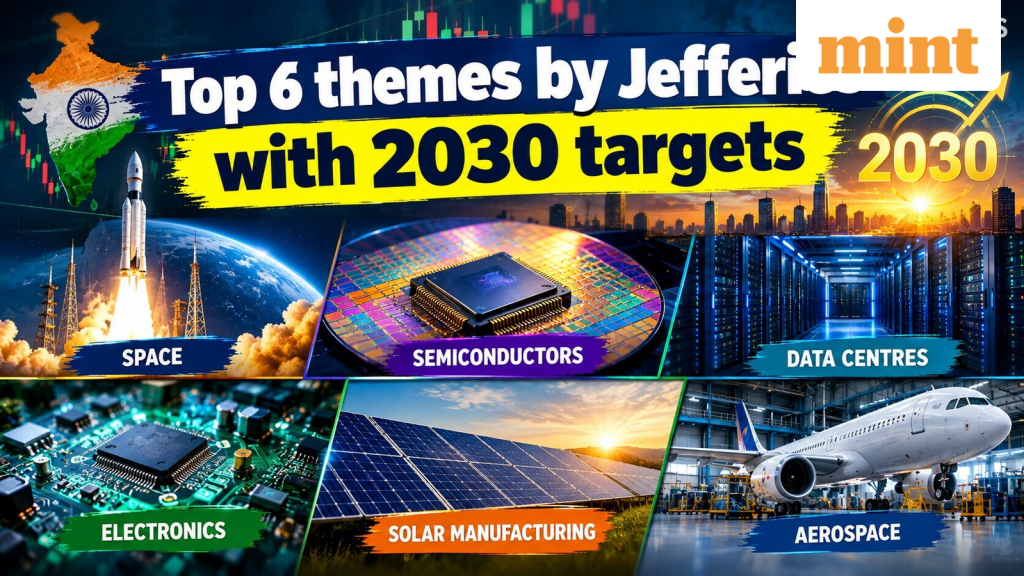
Mapping India’s Economic Roadmap Toward 2030
Global financial services firm Jefferies has released a comprehensive India Equity Strategy report detailing pivotal themes expected to drive the country’s economic expansion through 2030. As international investors seek long-term growth opportunities in emerging markets, India stands out due to its demographic advantages, policy stability, and ambitious industrialization goals.
The strategy highlights a major transition in the Indian economy: a shift from consumption-dominated growth toward capital expenditure and high-tech manufacturing. By establishing targeted initiatives across advanced sectors, India aims to strengthen its self-reliance while integrating deeper into global supply chains.
Semiconductor Manufacturing: Moving from Vision to Execution
A major focal point of the Jefferies analysis is India’s semiconductor landscape. The sector is rapidly transitioning from strategic policy formulation to tangible on-the-ground implementation. Backed by central and state government incentive frameworks, approximately $20 billion in capital investments are currently being deployed into domestic chip fabrication and assembly facilities.
Key developments driving this semiconductor push include:
- Establishment of Outsourced Semiconductor Assembly and Test (OSAT) units across key industrial corridors.
- Joint ventures between domestic conglomerates and established international chipmakers.
- Targeted subsidies under the India Semiconductor Mission (ISM) designed to lower entry barriers.
- Rising local demand driven by consumer electronics, automotive manufacturing, and telecommunications infrastructure.
These capital commitments aim to insulate the domestic market against supply chain vulnerabilities while establishing India as an alternative hub for global semiconductor assembly and design testing.
Commercializing Space and Satellite Technology
India’s space industry represents another primary growth driver identified in the 2030 framework. Following recent regulatory liberalizations, the sector has opened significantly to private enterprise, moving beyond the historical monopoly of state-run agencies.
Public-private partnerships and private space startups are expanding rapidly in areas such as satellite launch vehicles, earth observation networks, and low-cost communications infrastructure. Strategic reforms have lowered barriers for private capital, encouraging foreign direct investment and fostering an ecosystem capable of competing in the commercial satellite market.
Aerospace Expansion and Defense Localization
The aerospace sector in India is experiencing unprecedented momentum, fueled by two distinct catalysts: a domestic commercial aviation boom and intense government focus on defense indigenization.
Commercial airlines in India have placed record-breaking aircraft orders over recent years, prompting global aerospace original equipment manufacturers (OEMs) to expand their local supply chains, maintenance facilities, and component manufacturing operations. Concurrently, government policy requiring increased domestic content in defense procurement has redirected substantial capital toward local aerospace engineering and defense equipment manufacturing.
Secondary Strategic Themes Shaping 2030
In addition to space, semiconductors, and aerospace, the Jefferies equity strategy outlines three other essential structural themes expected to deliver robust long-term returns:
- Renewable Energy Transition: Substantial scale-up in solar, green hydrogen, and battery storage capacity aimed at meeting aggressive decarbonization goals.
- Advanced Electronics Manufacturing: Expansion of the Production Linked Incentive (PLI) schemes beyond smartphones into consumer appliances, industrial automation, and medical devices.
- Modernized Infrastructure and Mobility: Accelerated construction of high-speed rail corridors, modernized ports, and electric vehicle charging ecosystems to streamline logistics.
Key Considerations for Global Investors
While the long-term fundamentals remain strong, the strategic report emphasizes that realization of these 2030 targets depends heavily on sustained execution. Corporate earnings growth, infrastructure completion timelines, and foreign direct investment flows will serve as critical indicators over the coming years.
Additionally, investors must navigate global macroeconomic headwinds, interest rate cycles, and potential short-term valuation pressures in fast-growing mid-cap and small-cap market segments.
Conclusion
The Jefferies India Equity Strategy offers a clear blueprint of the structural forces propelling the country toward its 2030 economic milestones. With roughly $20 billion already committed to semiconductor initiatives and deep structural reforms accelerating sectors like space and aerospace, India’s economic story is increasingly defined by high-value technology and advanced industrial capacity.